By Sarawakian
The weather has been stifling. The extremely hot weather makes most of us uneasy. The sudden rainstorms which fell on some days within the same week felt angry. It felt as if we were being punished.
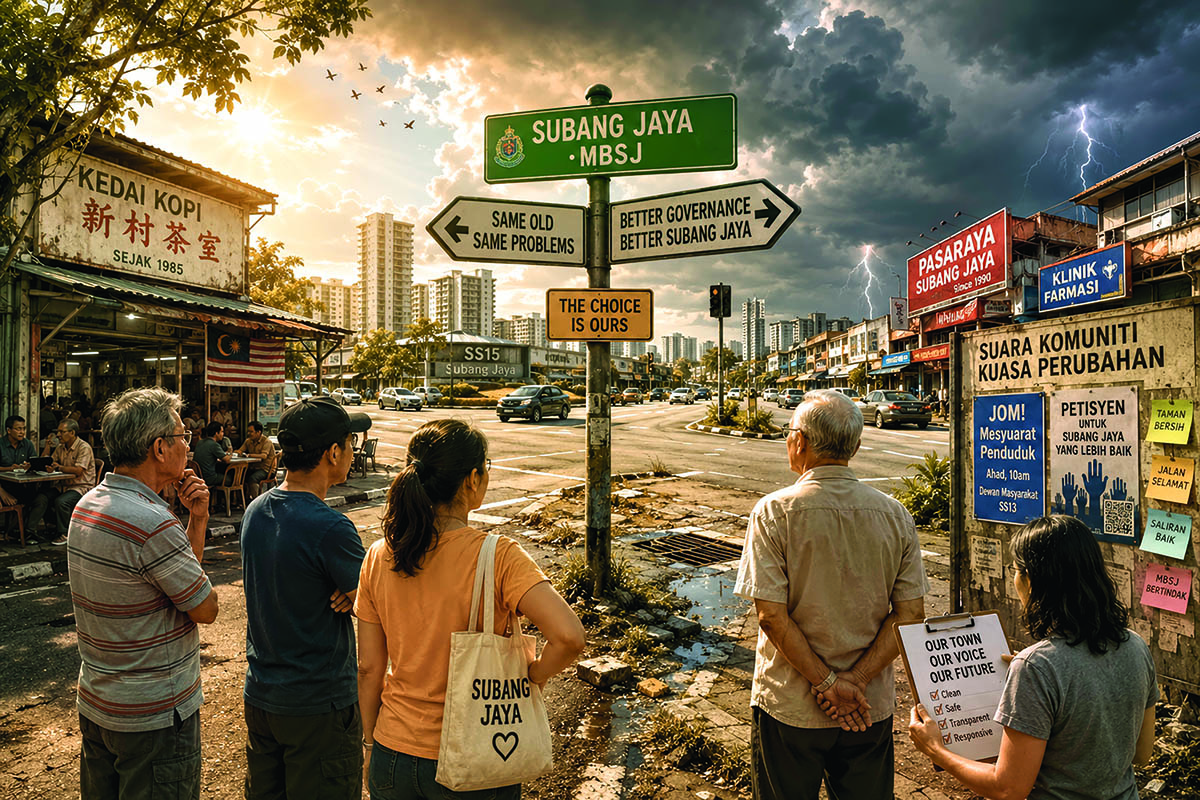
Subang Jaya has indeed reached a crossroad. The general feeling amongst the people and the close-knit community is uncomfortable. The coffee shop chatter has progressively changed tone. A storm is brewing ahead based on the general observation.
It is time again. The feeling is familiar because it always begins with discontent. Many of us recognize the symptoms: frustration repeated at coffee shops, complaints whispered in groups, and a growing sense that the same problems are being discussed without real resolution. When a community reaches this stage, delay is no longer harmless. If the disease is not treated soon, it will become accepted as part of everyday life.
We must also be honest enough to blame ourselves. We failed to keep the pressure on those who asked for our trust. We rested for too long. Many became blind supporters, believing that once change was delivered, those chosen should be granted excessive time and unquestioned loyalty. That belief has failed us. No representative, no party and no local authority should ever be given a blank cheque.
We are at a crossroads, and we must decide the path again. The easy argument is to say that if change did not bring the improvement we expected, then change itself is useless. That argument is tempting, but it is also dangerous. The failure of one promise does not mean we abandon the power to demand better. It means we become wiser, firmer and less forgiving of excuses.
This is where we must take a deep breath and choose courage over comfort. We cannot sit back and hope that things will somehow correct themselves. Hope without pressure becomes permission for inaction. We gave too much blind faith to our representatives and too much patience to our local government. Patience is a virtue only when it leads to progress; when it protects delay, it becomes surrender.
The community of Subang Jaya became complacent. Many of the agents of change had aged and became the voices of the past. That was the past who gave hope to those who lived through those years pre and immediately past 2008. The proof that when people are united, things happen. Hope becomes a reality. Change was not feared but embraced.
Subang Jaya is at a crossroad. We have seen how Subang Jaya has been stuck in a rather uncompromising situation on many occasions. Real issues remain a sore point. The simple focus of SS15’s improvements for hygiene sanitation, road conditions and safety had been discussed for decades post 2008 but have gradually grinded back to a near status quo today in 2026.When did it start? I dare say that post Covid 19 was the turning point.
How does this play into the hands of our politicians? Too easily. Politicians understand that visibility can be mistaken for performance. They know that many voters are satisfied by appearances: a visit, a photograph, a speech, a banner, a post on social media. When elections approach, the propaganda machine is dusted off, and suddenly everyone becomes visible again. But visibility is not governance. Presence is not progress. Public relations cannot repair roads, clean drains or restore public confidence.
The danger for any maturing township is not merely poor maintenance or delayed action. The greater danger is when people begin to accept decline as normal. A broken pavement becomes part of the scenery. A clogged drain becomes something normal. Trees get murdered instead of being pruned. When this happens, the standard of expectation slowly drops, and those entrusted with responsibility benefit from that lowered expectation.
This is why the present discomfort must not be dismissed as mere complaining. Complaints, when repeated by ordinary people across different corners of the community, are warnings. They tell us that the social contract between residents, local government and elected representatives is weakening. People do not expect miracles, and they know a city cannot be perfected overnight. But they have every right to expect sincerity, consistency and visible results. The basics must be done well before grand announcements are celebrated.
For Subang Jaya, the issue is also emotional. This is not a place without history. Many families built their lives here, sent their children to school here, opened small businesses here and formed friendships that lasted decades. The tamans carry memories of civic action, residents’ meetings, petitions, campaigns and small victories that once made people believe their voices mattered. When such a community feels ignored, the disappointment cuts deeper because it comes from a place of attachment rather than indifference.
We should therefore refuse to reduce this crossroad to a simple question of personalities or party colours. It is bigger than that. It is about the standard of governance that residents are prepared to demand. It is about whether accountability appears only during election seasons or becomes a daily expectation. It is about whether elected representatives are remembered for banners, visits and speeches, or for the difficult, measurable work of solving persistent problems that affect daily life.
The younger residents must also be drawn into this conversation. They may not remember the struggles before 2008, and they may not feel the same emotional weight attached to earlier political awakenings. Yet they are the ones who inherit the consequences of today’s apathy. If they see public life as nothing more than noise, cynicism and staged appearances, they will withdraw further. If they see meaningful participation, honest debate and tangible results, they may begin to believe that local democracy is not an abstract idea but a living responsibility.
At the same time, residents must be honest with themselves. It is easy to blame politicians and officers, but it is harder to admit that public pressure faded when life became more comfortable. It is harder to admit that many preferred to grumble privately rather than organise collectively.
A community cannot expect better governance if it speaks only in kopitiam whispers. Respectful pressure must return. Questions must be asked publicly. Records must be kept. Promises must be remembered. Representatives must understand that visibility alone is no longer enough; results must follow. Be brave.
It is not only about choosing between old and new representatives. It is about deciding whether Subang Jaya will continue waiting for another wave of anger before demanding better. The weather may be hot, and the storm clouds may gather, but the direction ahead still depends on the people. If Subang Jaya wants better, it must not merely hope for better. It must insist on better, organise for better and vote with the memory of every promise made.