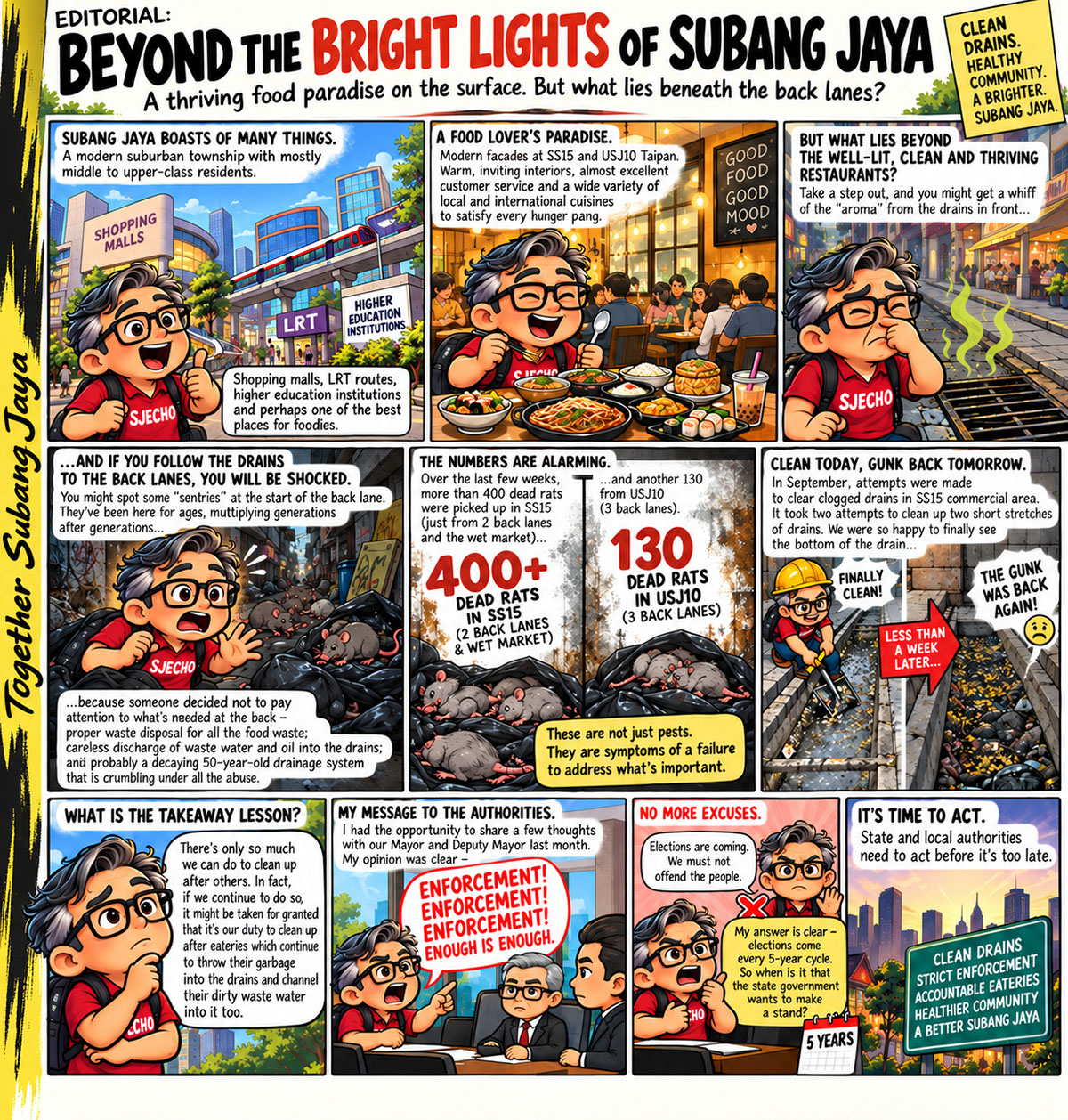
We cannot keep cleaning the drains while ignoring who keeps dirtying them.
Subang Jaya has much to be proud of.
We are a mature suburban city, home to a largely middle- and upper-income population, surrounded by modern shopping malls, LRT connectivity, institutions of higher learning and, arguably, one of the Klang Valley’s most exciting food scenes.
Walk through SS15 or USJ10 Taipan and you see the Subang Jaya we like to showcase.
Modern façades. Brightly lit cafés. Bustling restaurants. Trendy coffee shops. Warm, inviting interiors and generally good customer service. From hawker favourites to international cuisine, there is probably something within a few streets to satisfy almost every craving.
But walk out the door – then look down – and perhaps, hold your nose.
Because just beyond the polished shopfronts and beautifully presented plates lies another Subang Jaya – one that customers rarely see. Follow the drain from the front of the shoplot towards the back lane and the picture can change dramatically.
There, you may encounter some of our oldest and most persistent “residents” -Rats.
Not one or two scurrying for cover, but colonies that appear to have survived and multiplied through generations.
This is no longer merely anecdotal. On September 19, MBSJ collected 426 rat carcasses around SS15 following a rat-poisoning operation the previous day. MBSJ subsequently said cleanliness management and environmental-control efforts would continue to be intensified.
That number should make us uncomfortable. Not simply because there were 426 rats, but because we should be asking what sustained such a population in the first place.
Rats are the symptom. The environment is the problem. Rats do not establish thriving colonies without food, water and shelter.
When back lanes become dumping grounds, when food waste is improperly disposed of, when wastewater and grease enter drains, and when ageing drainage infrastructure struggles under decades of use and abuse, we should hardly be surprised when pests flourish.
The rat is what we see.
The conditions that feed the rat are what we need to fix.
And there is an uncomfortable irony here. MBSJ’s own May 2026 listings show numerous USJ10 restaurants carrying Grade A classifications. A restaurant may therefore present an excellent dining environment to its customers, yet the wider question remains: what happens to its waste after it leaves the kitchen?
That is why cleanliness cannot end at the kitchen door. It must extend to the drains, grease traps, rubbish storage areas and back lanes.
Clean today. Gunk tomorrow.
September gave us another lesson. Attempts were made to clear badly clogged drains in the SS15 commercial area. Two short stretches required repeated work before we could finally celebrate something that should hardly be extraordinary:
We could see the bottom of the drain again.
It felt like an achievement. Then, in less than a week, the gunk was back. And therein lies the problem.
How many times are we supposed to clean the same drain? How many gotong-royong exercises do we organise?
How many times should council workers, contractors, residents and community representatives clear rubbish and sludge before we acknowledge that repeatedly cleaning the consequences does not address the behaviour creating them? There is only so much cleaning anyone can do when the tap remains open.
Worse, constantly cleaning up without addressing the source risks creating the expectation that somebody else will always come along and clean the mess. That cannot become the operating model for Subang Jaya.
Enforcement. Enforcement. Enforcement.
Last month, I had the opportunity to share some thoughts with our Mayor and Deputy Mayor. My position was straightforward:
Enforcement. Enforcement. Enforcement.
Education matters. Engagement matters. Awareness campaigns have their place. But there comes a point when people already know that dumping food waste into a drain is wrong.
There comes a point when businesses should know that discharging dirty wastewater or oil irresponsibly is unacceptable. At that point, another poster, another reminder and another friendly warning achieve very little.
Rules without consequences eventually become suggestions.
MBSJ has used enforcement against food premises before. In a documented 2022 operation at USJ10 Taipan, 56 food premises were inspected and 10 compound notices were issued for various violations of food-handling requirements. At the time, MBSJ said it would continue monitoring and enforcement to protect public health.
That principle remains relevant today.
Where there is evidence of an offence, investigate it. Where an offence is established, enforce the applicable rules consistently and transparently. And if existing regulations or infrastructure are inadequate, say so and fix them.
Public health should not follow the election calendar
I also reject the argument that enforcement should become timid because elections are approaching and authorities should avoid offending people. Elections are part of democratic government. Enforcement of legitimate public-health, cleanliness and business regulations is part of governing.
The two should not be confused.
Elections will come and go. Drains will still need to flow. Waste will still need to be properly disposed of. Restaurants will still have responsibilities to their customers and their surroundings. Residents will still expect their local authority to protect public spaces. The relevant question is therefore not which political side benefits or suffers from enforcement.
It is much simpler:
Are the rules reasonable, are they applied fairly, and are they enforced consistently? If the answer is yes, authorities should not apologise for doing their job.
Residents, businesses and authorities all have responsibilities here. Enforcement should not become an excuse to ignore ageing infrastructure, inadequate waste facilities or poor municipal maintenance. Likewise, infrastructure problems cannot become an excuse for irresponsible business practices.
Both sides of the equation have to be addressed.
The front door and back door must tell the same story
Subang Jaya has spent decades growing into the city we see today. We have impressive malls, busy commercial centres, universities, rail connectivity and restaurants capable of competing with some of the best anywhere in the Klang Valley. But a city should not be judged only by what visitors see from the front.
Look behind the shoplots. The condition of our back lanes, drains, rubbish collection points and service areas say just as much about us as the gleaming restaurant façades facing the main road.
Perhaps even more. Because civic pride isn’t keeping the dining table spotless while sweeping everything underneath it. The hundreds of rats collected in SS15 should therefore not become merely another statistic or another photograph forgotten after a few weeks.
They should be a warning.
Clean the drains, certainly. Repair ageing infrastructure where necessary. Provide workable systems for businesses to dispose of their waste responsibly. Educate where education is needed. But when businesses or individuals repeatedly ignore their responsibilities, enforce the rules.
Not next year. Not after another campaign. Not when it becomes politically convenient. Now!
Because the Subang Jaya we proudly display at the front deserves a back lane we don’t have to hide. Enough cleaning up after the problem. It is time to stop the problem at its source.